


For forty years, marketing rewarded people who knew things. Who had the data. Who understood the platforms. Who memorized the best practices and could recall them under pressure.
AI has read every playbook, every case study, every framework ever published. It retrieves and synthesizes that information in seconds. The competitive advantage of knowing more is gone. What remains is the ability to look at everything AI surfaces and decide what actually matters for your business, your market, your moment.
Judgment. That’s the new edge.
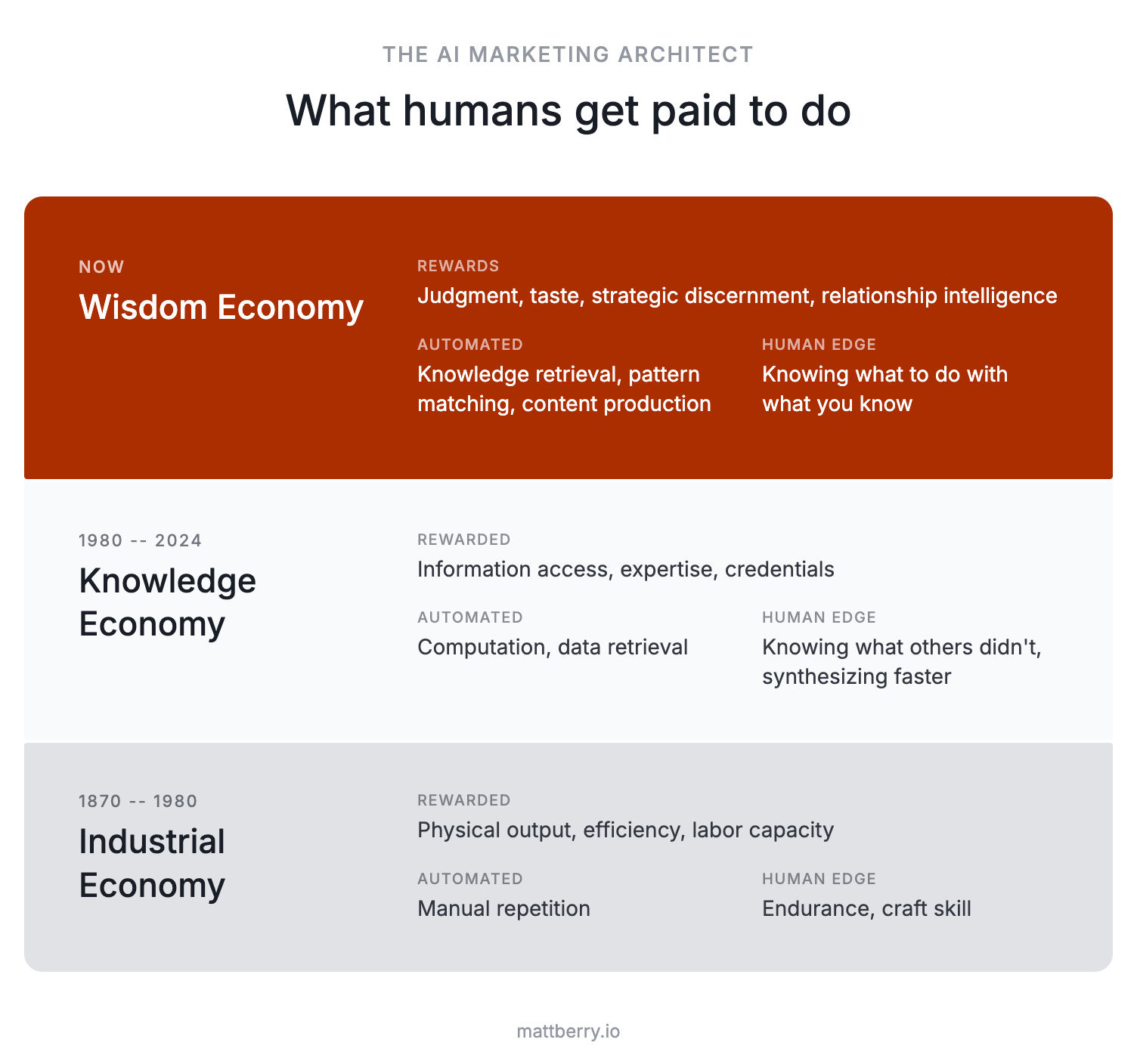
Three eras, three definitions of value
Economic eras are shifts in what humans get paid to do.
The Industrial Economy rewarded making things. Physical output, efficiency, labor capacity. When manual repetition got automated, the humans who showed up, endured, and mastered a craft with their hands still had jobs.
The Knowledge Economy rewarded knowing things. Information access, expertise, credentials. Computation and data retrieval got automated, but if you knew what others didn’t and could synthesize faster than your competitors, you were valuable.
The Wisdom Economy is different. Knowledge retrieval, pattern matching, content production are all being automated. The value that remains lives in judgment, taste, and the intelligence you can only get from real relationships. The edge is knowing what to do with what you know.
Most marketing teams haven’t crossed that line. They’re using AI to produce content faster, analyze data quicker, generate more variations, ship more campaigns per quarter. That’s new capability applied to old architecture. You go faster, but you haven’t changed what you’re building.
Process debt
Every marketing organization carries what I call process debt: the accumulated weight of workflows, handoffs, approval chains, and production steps that exist because humans historically needed them to manage complexity.
It’s the marketing equivalent of technical debt, but harder to see. It looks like “how we’ve always done things.” It feels like necessary rigor. It shows up in the meeting where seven people review copy that an AI could have generated, refined, and tested in the time it took to schedule the calendar invite.
These processes were once solutions. They solved real coordination problems: moving information across teams, maintaining quality when production was manual, managing handoffs between specialists who each held a piece of the picture. But those constraints are gone. The information bottlenecks collapsed. The coordination costs evaporated. The processes survived because nobody audited them against what’s now possible.
The test is simple. If a process exists to move information between humans or compensate for limited bandwidth, it’s probably debt. If it exists because someone needs to apply judgment, build a relationship, or make a call that could go either way, it’s probably real work.
The fatigue is the tell
There’s an exhaustion spreading through marketing organizations right now. Leaders drowning in AI tools, AI announcements, AI “transformation” initiatives. Every week brings a new platform.
People are trying to apply Knowledge Economy habits (consume everything, evaluate every tool, stay current on every development) to a landscape that punishes exactly that behavior.
That fatigue is diagnostic. People are trying to apply Knowledge Economy habits (consume everything, evaluate every tool, stay current on every development) to a landscape that punishes exactly that behavior. When information access was the competitive advantage, relentless consumption made sense. Now the advantage belongs to people who filter ruthlessly and trust their own judgment.
The teams getting real results are the ones eliminating process debt. They ask which of their current workflows exist because of constraints AI has already removed, and then they actually kill those workflows. That’s a question about organizational design. “How do we use AI?” is a question about tool adoption. Big difference.
What survives
Gartner projects that by 2027, 95% of B2B buyer journeys will start in LLM assistants rather than traditional search. Every content strategy, SEO playbook, and demand gen funnel built over the past decade assumes buyers search Google, find your content, enter your forms, and move through your nurture sequences. That entire chain starts to look like the most expensive process debt on the books.
So what work actually survives?
Start with desire creation: making people want something they didn’t know they needed. AI can generate copy all day. It cannot want, and you can’t prompt your way to appetite. Seeing a market before it exists and building hunger for something nobody is asking for yet, that’s still a human job.
Strategic judgment…is the single most important skill in the Wisdom Economy
Then there’s strategic judgment, which I’d argue is the single most important skill in the Wisdom Economy. Every AI system gives you the statistically optimal recommendation. The CMO who can feel when the optimal answer is wrong (because the market is shifting or the brand needs to take a risk) gets more valuable every year. Choosing what to ignore is harder than choosing what to pursue, and no model is good at it.
Trust and taste round out the picture, though they work differently. Trust is accountability between humans. Your AI agent can book the meeting and prep the deck, but it cannot make someone feel understood across the table or own the outcome when things break. Taste is knowing what the brand should sound like in a moment with no precedent. AI is a weak creative partner for anyone who lacks strong instincts, because the bottleneck was always the quality of creative direction. The person who looks at ten outputs and immediately knows which one has the right feel is playing a different game than the person who generated all ten.
Smaller teams, bigger calls
Teams will shrink. Org structures that made sense five years ago stop making sense when AI collapses the coordination cost between functions. Content, ops, demand gen, sales enablement: these divisions exist because humans needed them to manage information flow. When AI handles coordination, the divisions become overhead.
What replaces them looks more like a small pod that operates across the full go to market motion, from first website visit to renewal. The pod identifies where human judgment creates leverage and builds systems to handle everything else.
The CMO role changes with it. Less people management, more hands on craft involvement. The most effective marketing leaders in this next era will be the ones who stayed close to the work and kept their creative instincts sharp.
Domain expertise plus AI fluency is the most valuable combination in any organization right now. Deep knowledge of your market (the judgment, the pattern recognition that comes from years of immersion) plus the ability to direct AI systems against that knowledge. That pairing is rare today. It won’t stay rare. But the people building it now have a head start that gets harder to close every quarter.
The process debt audit
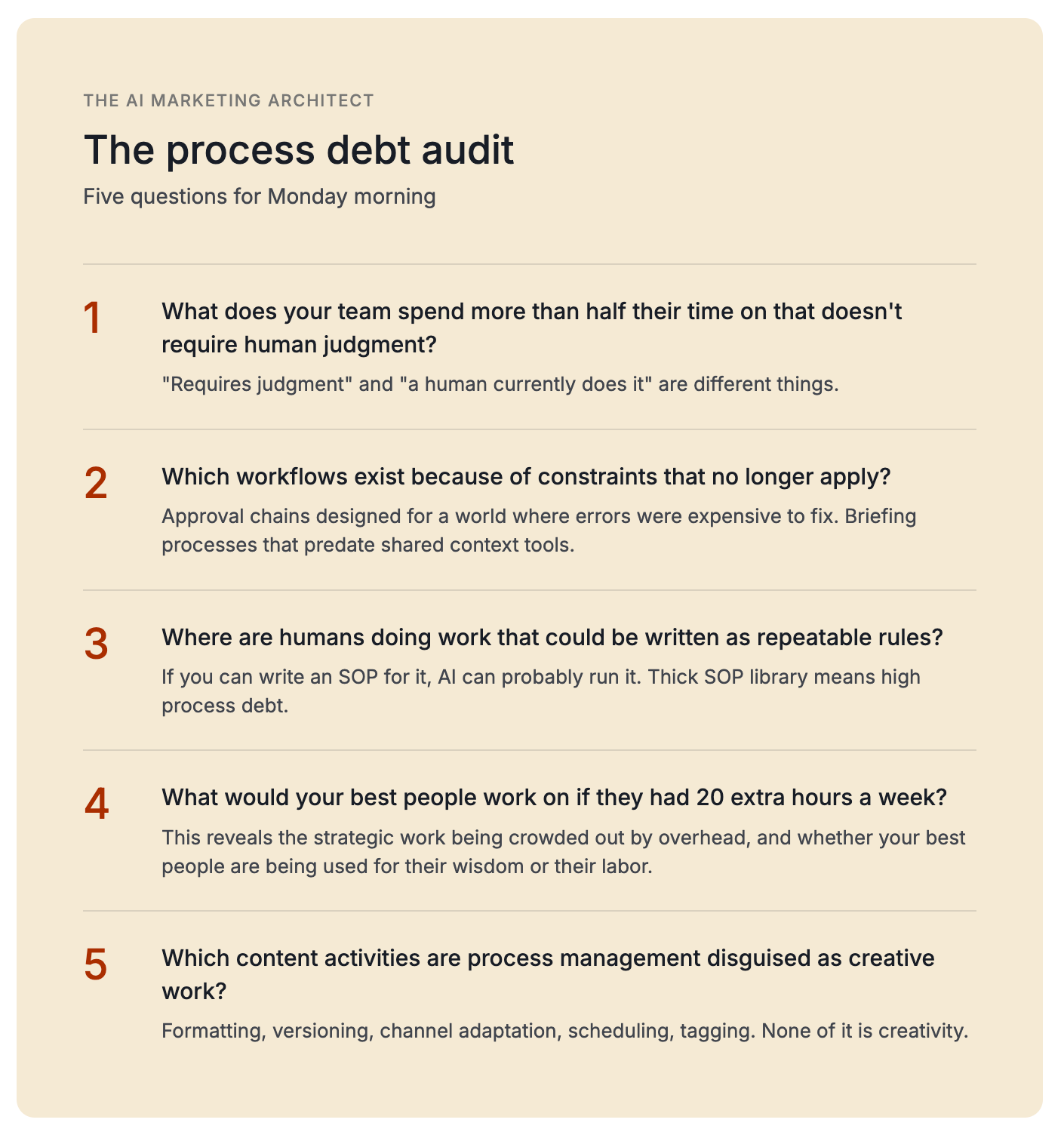
Five questions any CMO can run Monday morning:
What does your team spend more than half their time on that doesn’t require human judgment? Be honest. “Requires judgment” and “a human currently does it” are different things.
Which workflows exist because of constraints that no longer apply? Approval chains designed for a world where errors were expensive to fix. Briefing processes that predate shared context tools.
Where are humans doing work that could be written as repeatable rules? If you can write an SOP for it, AI can probably run it. An untenable SOP backlog means high process debt.
What would your best people work on if they had 20 extra hours a week? This reveals the strategic work being crowded out by overhead, and whether your best people are being used for their wisdom or their labor.
Which content activities are process management disguised as creative work? Formatting, versioning, channel adaptation, scheduling, tagging. None of it is creativity. All of it eats creative people’s time and makes them feel productive without making the organization smarter.
Run this audit. Write down the answers. You’ll have a map of where AI should actually be deployed first.
Where this leaves us
The Knowledge Economy made a lot of marketing careers possible. Information accumulation and process management were valuable when they were scarce.
They’re not scarce anymore.
The Wisdom Economy asks a harder question: once AI knows everything you know and can produce everything you produce, what do you bring?
Once AI knows everything you know and can produce everything you produce, what do you bring?
Judgment. Taste. Strategic courage. The capacity to earn trust from other humans.
The leaders who start paying down process debt now, who free their teams for genuine thinking instead of production choreography, will pull away from the ones still optimizing workflows that shouldn’t exist anymore. That gap is already opening. Two years from now it will be obvious who made the shift and who kept running the old playbook faster.
What’s the one workflow your team spends 80% of their time on that produces 20% of the value? Hit reply. I’ll share the patterns I’m seeing across organizations in a future issue.