


The process debt playbook
Last month I introduced the idea of process debt: the accumulated weight of workflows, handoffs, and approval chains that exist because humans historically needed them to manage complexity that AI has now removed.
The response was clear. People recognized it immediately. Almost every reply was some version of the same question: "OK, but how do I actually find it and get rid of it?"
Fair. Naming the problem was step one. Here's step two.
Process debt has types
Most organizations struggle to eliminate process debt because they treat it as one thing. "We have too much process" is too vague to act on. It's like telling a doctor "I feel bad." You need a diagnosis before you can prescribe.
Process debt shows up in four patterns. Each has different root causes and needs a different fix. Treating them all the same way means you'll solve some and make others worse.
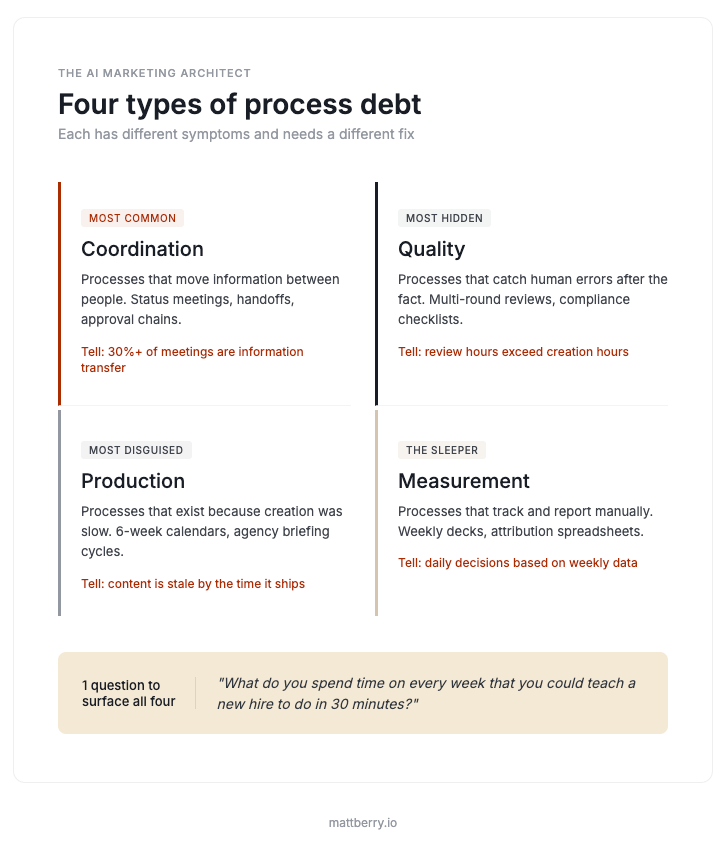
Coordination debt
This is the most common type I see, and the one most leaders are blind to because it looks like collaboration.
Status meetings, handoff documents, briefing decks, approval chains, the email thread where three people clarify what another person meant in a Slack message. These were solutions to a real problem: humans working in different places, on different schedules, with different context. Moving information between them required deliberate effort.
AI collapses that cost. A shared context layer means the information doesn't need a human courier. The meeting that existed to align five people can become a document that five people read on their own time, generated from the same shared context.
Look at your calendar. If more than 30% of your meetings exist to tell other people what happened, you're carrying heavy coordination debt.
Quality debt
Multi-round review cycles, brand compliance checklists, legal review queues, copy editing passes, the two-day turnaround where a director reads every piece of content before it ships. All of this was built for a world where producing a bad draft was expensive and catching errors early saved rework downstream.
That constraint is gone. Style guides, brand voice rules, compliance requirements, formatting standards: these can all be embedded in the production system. The review cycle that catches 90% of issues after the fact can be replaced by a quality layer that prevents 90% of issues before the first draft exists.
The tell: your team spends more time reviewing work than creating it. If the ratio of review hours to creation hours is above 1:1, your quality gates are doing remediation that should be built into the production layer.
Production debt
This one hides behind the word "planning."
Content calendars with six-week lead times, batch production workflows, agency briefing cycles with two weeks of back and forth before a single deliverable ships, asset versioning pipelines where adapting one piece for a different channel takes a full day. All rational when making things took a long time. You planned far in advance because you had to.
AI compresses production timelines from weeks to hours. A byline that took five days can take one. A campaign that required a month of asset production can ship in a week. But only if you actually change the timeline. Most teams adopt AI tools and keep the six-week calendar because the calendar feels like planning and planning feels responsible.
You can spot this one easily: your content is routinely stale by the time it ships. If your team regularly publishes takes on developments that have already moved past the original angle, your production timeline is longer than your market's attention span.
Measurement debt
The sleeper. Nobody thinks of reporting as debt because it feels like accountability.
Weekly reporting rituals where someone spends four hours pulling data from six platforms into a slide deck. Attribution spreadsheets maintained by hand. Dashboard maintenance that eats a full day every month. Campaign tagging systems that require manual input at every step.
AI can do all of this continuously. The weekly report that takes a human four hours can be generated in minutes. The attribution model that requires manual stitching can run automatically. Which means the question shifts from "what happened last week" to "what should we pay attention to right now."
If your team makes daily decisions based on weekly data, measurement debt is forcing you to fly on stale instruments.
Five steps
Step 1: The time diary
Have every person on the team log what they actually do for one full week. What they actually spend time on, tracked in 30-minute blocks. Not the job description version. The real version.
People will resist this because tracking feels like surveillance. Be direct about what it is: the system is what's being evaluated. You want to know where the team's time goes so you can protect the time that matters most.
The gap between perceived time allocation and reality is almost always wider than expected. Activities that feel like five minutes often eat an hour when you add up the context switching and the follow-through.
Step 2: Categorize
Take every activity from the time diary and sort it: coordination debt, quality debt, production debt, measurement debt, or real work.
Real work is anything that requires human judgment or relationship. A conversation with a customer where you're reading their reaction and adjusting live. A creative decision where both directions have strong arguments. A strategic call where the data goes both ways and someone has to pick.
The labeling itself changes the conversation. Once a two-hour weekly status meeting gets tagged as coordination debt, people stop debating whether the meeting is useful and start asking whether the underlying need (information transfer) can be met without it. Usually it can.
Step 3: Score and prioritize
Two dimensions: how many hours per week does this consume across the team, and how much effort to eliminate or redesign it.
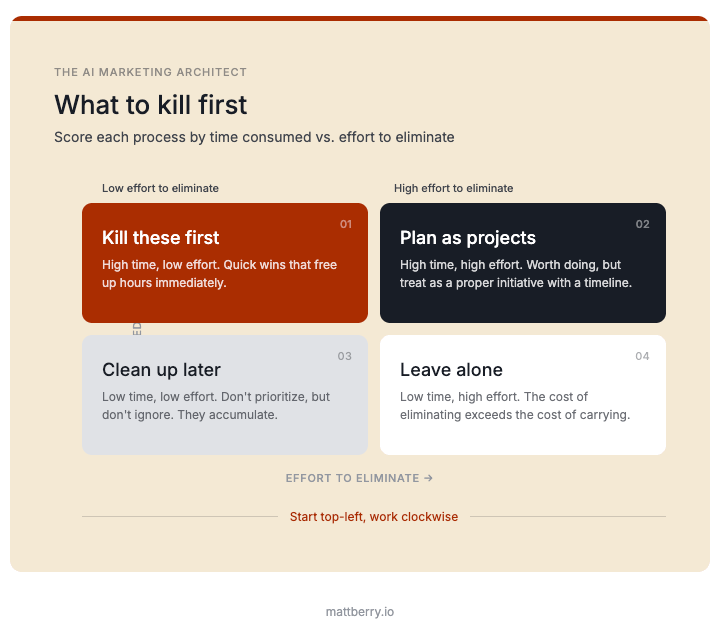
High time and low effort to eliminate? Kill those first. That's where you free up real hours fast. High time but high effort? Those are projects. Plan them with clear timelines and commit to them.
Low time and low effort can wait until you have a spare afternoon, but don't ignore them. They accumulate. Low time and high effort? Leave them alone. The cost of eliminating them is higher than the cost of carrying them.
Step 4: Kill, redesign, or keep
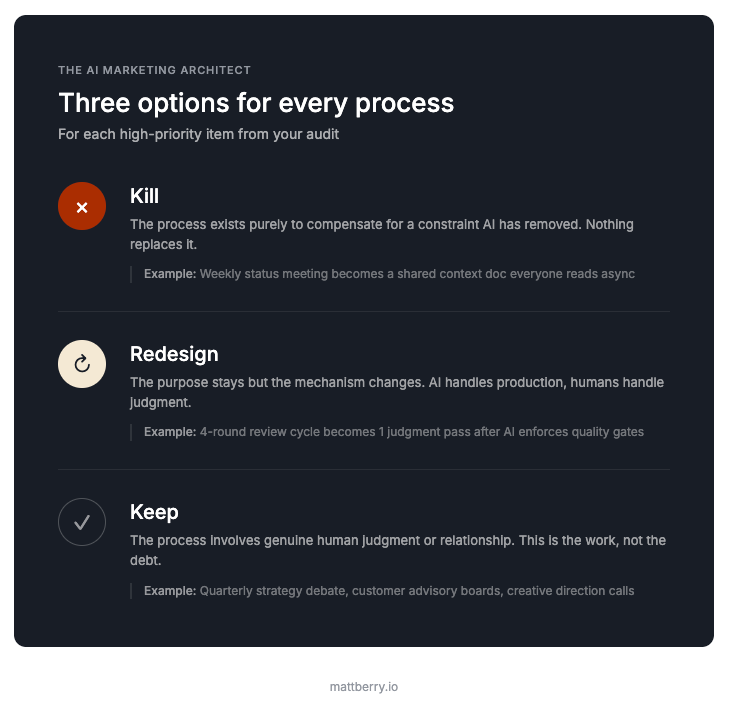
For each high-priority item, three options.
Kill means the process goes away entirely and nothing replaces it. The weekly status meeting that transfers information between teams? Replace it with a shared context layer everyone can access asynchronously. If someone needs a decision, they book a 15-minute decision meeting. Information transfer doesn't need a recurring calendar invite.
Redesign means the purpose stays but the mechanism changes. Take the multi-round content review cycle. Embed quality gates into the production layer so content meets brand and compliance standards before a human sees it. The human review becomes a judgment call (does this say something worth saying?) instead of proofreading (did we spell the product name right?). One pass instead of four.
Keep means the process involves genuine judgment or relationship and it stays. The quarterly strategy session where the leadership team debates market positioning? That's real work. The customer advisory board meeting? Real work. Don't confuse debt with discipline.
Step 5: Measure the delta
Run the time diary again 30 days after changes take effect. Quantify the hours recovered.
Then ask the harder question: what did people do with the freed time?
If the answer is "produce more content, run more campaigns, ship more assets," you got more efficient at the old model. You went faster without going somewhere different. The freed time should be going into customer conversations, strategic planning, creative exploration where there's no deliverable attached. The thinking that produces the one insight that makes everything else land.
If your people got 15 hours back and spent them on the same kind of work, you need a different conversation. That one is about what your team is actually for.
The Monday morning version
If you don't have time for the full playbook, start here.
Ask your team one question: "What do you spend time on every week that you could teach a new hire to do in 30 minutes?"
Anything that fits that description is process debt. The skill required to do it is low. The time it eats is high. And a senior person is still doing it because nobody stopped to ask whether they should be.
That question alone will surface enough for your first round of changes.
Where this goes
Once you've cleared the debt, the deeper question is what you build in its place. The answer is structural, and it's the subject of a future post.
Next week I'll share field notes from running this playbook on my own team. Four people, enterprise tech marketing. What we found, what we killed, and what hope to happen when the time came back.
What's the biggest category of process debt on your team? I'm betting coordination debt wins for most orgs. Reply and tell me if I'm wrong.